
Can You Travel or Fly After a Steroid or Hyaluronic Acid Injection?
Reviewed by:
Muhammad Asim Ishaque MSc, PG Cert MSK Ultrasound, Dip MSK Medicine, PG Cert Non-Medical Prescribing, MCSP, MAPPN
Dr. Sameer Gohir PhD, MSc, PG Cert MSK Ultrasound, PG Cert Non-Medical Prescribing, MCSP, MAPPN
About this guide: Practical advice about flying and significant travel after routine peripheral joint corticosteroid or hyaluronic acid injections. Follow the individual advice provided by your treating clinician.
At Joint Injection Clinic (JIC), we are often contacted by patients who are due to travel and ask whether they can have a corticosteroid or hyaluronic acid injection on the same day as, or the day before, their flight.
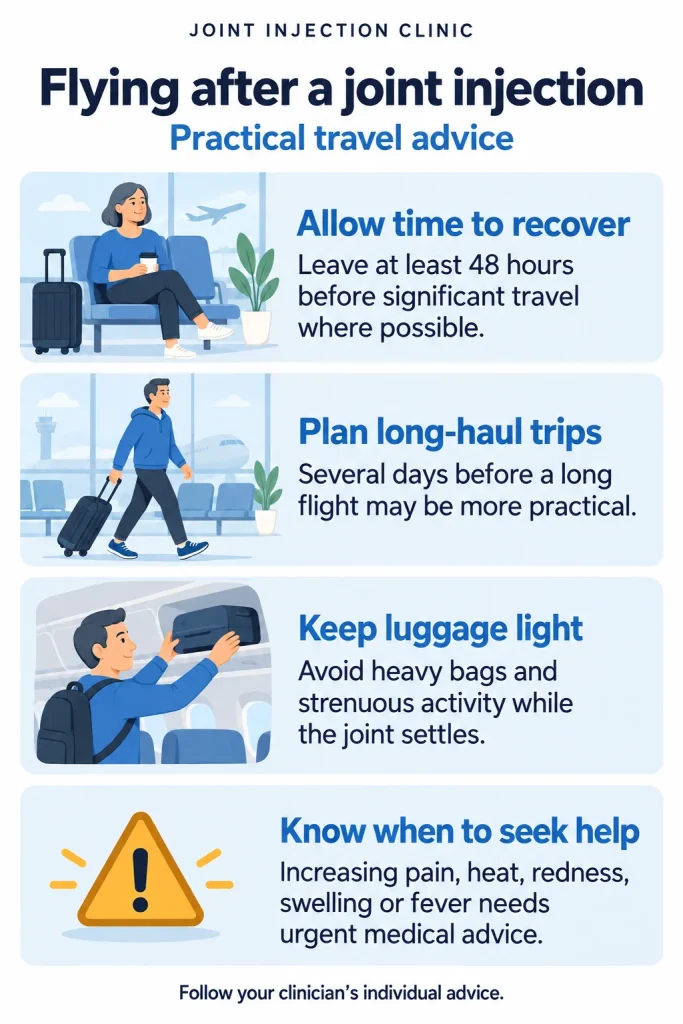
We generally recommend allowing at least 48 hours between your injection and significant travel, where possible.
This is practical clinical advice rather than a fixed aviation rule, and your clinician will advise you based on your individual circumstances.
It is an understandable question. If you are struggling with knee, hip, shoulder or other joint pain just before a holiday, having an injection before your planned journey may sound like a good idea.
However, an injection is a medical procedure, and it is sensible to allow some time afterwards for the treated area to settle.
This guide answers some of the common questions we receive about having a joint injection before air travel and explains how much time we generally recommend leaving between your injection and your journey.
Why does the timing of your injection matter before flying?
Following either a corticosteroid or hyaluronic acid (HA) injection, some patients experience temporary soreness, stiffness or swelling around the treated area. This usually settles, but it can be inconvenient if it develops while you are at the airport, during a long flight or once you are already abroad.
There is also a very small risk of infection following any injection. Increasing pain, redness, heat or swelling around the joint, particularly if associated with fever or feeling generally unwell, requires urgent medical assessment.
Travelling immediately after an injection can also make it difficult to rest the treated area. Walking through an airport, standing in queues, carrying luggage and then sitting for several hours may make the journey uncomfortable while the joint is settling.
Can I fly on the same day as a corticosteroid injection?
A cortisone (corticosteroid) injection is commonly used to reduce pain and inflammation in or around a joint.
There is no general rule that prohibits flying as a passenger after a routine peripheral joint corticosteroid injection. However, we generally advise avoiding same-day travel where possible so that you have time to see how the treated area responds.
A corticosteroid injection can occasionally cause a temporary increase in pain, often referred to as a post-injection flare. The steroid itself does not necessarily work immediately either. Although local anaesthetic, when used, may provide some temporary early pain relief, the corticosteroid usually takes a few days to produce its effect.
For this reason, at Joint Injection Clinic, we generally recommend allowing at least 48 hours between a corticosteroid injection and significant travel where possible. For a long-haul flight or an important holiday, having the injection several days beforehand may be more practical.
This gives the treated area time to settle and allows you to see how you respond to the injection before travelling. It does not guarantee that the injection will have provided its full benefit by your departure date.
For advice about rest, driving, exercise and managing discomfort, please see our cortisone injection aftercare guide.
Can I fly after a hyaluronic acid injection?
Hyaluronic acid injections—sometimes referred to as HA, gel injections or viscosupplementation—work differently from corticosteroid injections. They are used in the management of joint pain, particularly knee osteoarthritis.
Their effect is usually gradual rather than immediate. Some patients may experience temporary aching, fullness or swelling within the joint during the first day or two following treatment.
Having an HA injection does not automatically mean you need to cancel your travel plans. However, having the injection immediately before leaving for the airport offers little opportunity for the joint to settle, and the full benefit is unlikely to be felt during the journey.
As with corticosteroid injections, allowing time for the treated joint to settle can make travelling more comfortable. If you are planning an important holiday or long-haul journey, having the injection several days in advance may be preferable.
The time needed for initial discomfort to settle is different from the time needed to experience the treatment’s benefit, which varies between patients.
How long before travelling should I have my injection?
As a simple practical guide:
| Type of injection or travel plan | Our general travel advice |
|---|---|
| Corticosteroid injection | Allow at least 48 hours before significant travel where possible. Several days before a long-haul flight or important holiday may be preferable. |
| Hyaluronic acid injection | Allow at least 48 hours before significant travel where possible. Having the injection several days before your journey gives initial discomfort more time to settle; its benefits develop gradually. |
| Corticosteroid and HA injection in the same joint | We would also recommend allowing at least 48 hours before significant travel where possible, following your clinician’s individual advice. |
| Same-day travel after either injection | Best avoided where possible. If travel cannot be changed, discuss this with your clinician before proceeding with the injection. |
These are practical clinical recommendations rather than fixed aviation rules. Advice should always be tailored to the individual patient.
If the joint remains significantly painful or swollen, or symptoms are worsening, seek advice rather than assuming that travelling is appropriate simply because 48 hours have passed.
Planning your injection around your holiday
If you are considering a joint injection before a holiday, please let us know about your travel plans when booking.
Tell us when you are leaving, how long your journey will take and whether your holiday involves substantial walking or other physical activity. For a long-haul flight or important holiday, arranging your injection several days beforehand provides a more practical window to assess your response.
It may also help to arrange assistance with luggage and, if walking is difficult, ask your airline or airport about assistance in advance. After a shoulder injection, lifting bags may be particularly uncomfortable; after a knee injection, long walks and standing in queues may be more demanding.
If your flight is on the same day or the following day, speak to our clinical team before your appointment so that we can consider your circumstances and advise you appropriately.
If increasing pain, redness, heat or swelling develops while you are away, particularly with fever or feeling unwell, seek urgent medical assessment locally rather than waiting until you return home.
Every patient is different. Planning ahead helps us advise you on the timing of your injection and the aftercare most appropriate for your journey.
Planning treatment with Joint Injection Clinic
If you are considering an injection before travelling, tell the clinical team about your departure date when booking. You can learn more about benefits of ultrasound-guided injections, view our clinic locations, or contact Joint Injection Clinic for routine questions. For urgent symptoms, seek prompt medical assessment rather than waiting for an email response.
References
These references support the general aftercare information. The suggested interval before travel reflects JIC’s practical clinical advice rather than a universal passenger-flight restriction.
- Uson J, et al. EULAR recommendations for intra-articular therapies. Annals of the Rheumatic Diseases. 2021;80:1299–1305.
- NHS. Side effects of hydrocortisone injections. This information relates specifically to hydrocortisone; follow the advice given for your medicine and procedure.
- Australian Rheumatology Association. Hyaluronic acid patient information.
- Guy’s and St Thomas’ NHS Foundation Trust. Steroid injections for joint and tendon pain.
This article provides general information and does not replace individual clinical advice. Follow the aftercare instructions provided by your treating clinician and discuss any questions about travelling with them.