Ultrasound-Guided Injections in Kings Hill, West Malling
Assessment, Scan and Injection in One Appointment — No GP Referral Required
Joint Injection Clinic provides private ultrasound-guided injections in Kings Hill, West Malling, for patients with joint pain, tendon problems, arthritis-related pain, bursitis, and soft tissue conditions.
Your appointment includes a specialist musculoskeletal assessment, diagnostic ultrasound scan where appropriate, and ultrasound-guided injection treatment if clinically suitable.
This allows your clinician to assess the painful area and identify the likely source of symptoms. Ultrasound guidance then helps the clinician place medication into the intended joint, bursa, tendon sheath or selected soft-tissue target while identifying nearby structures.
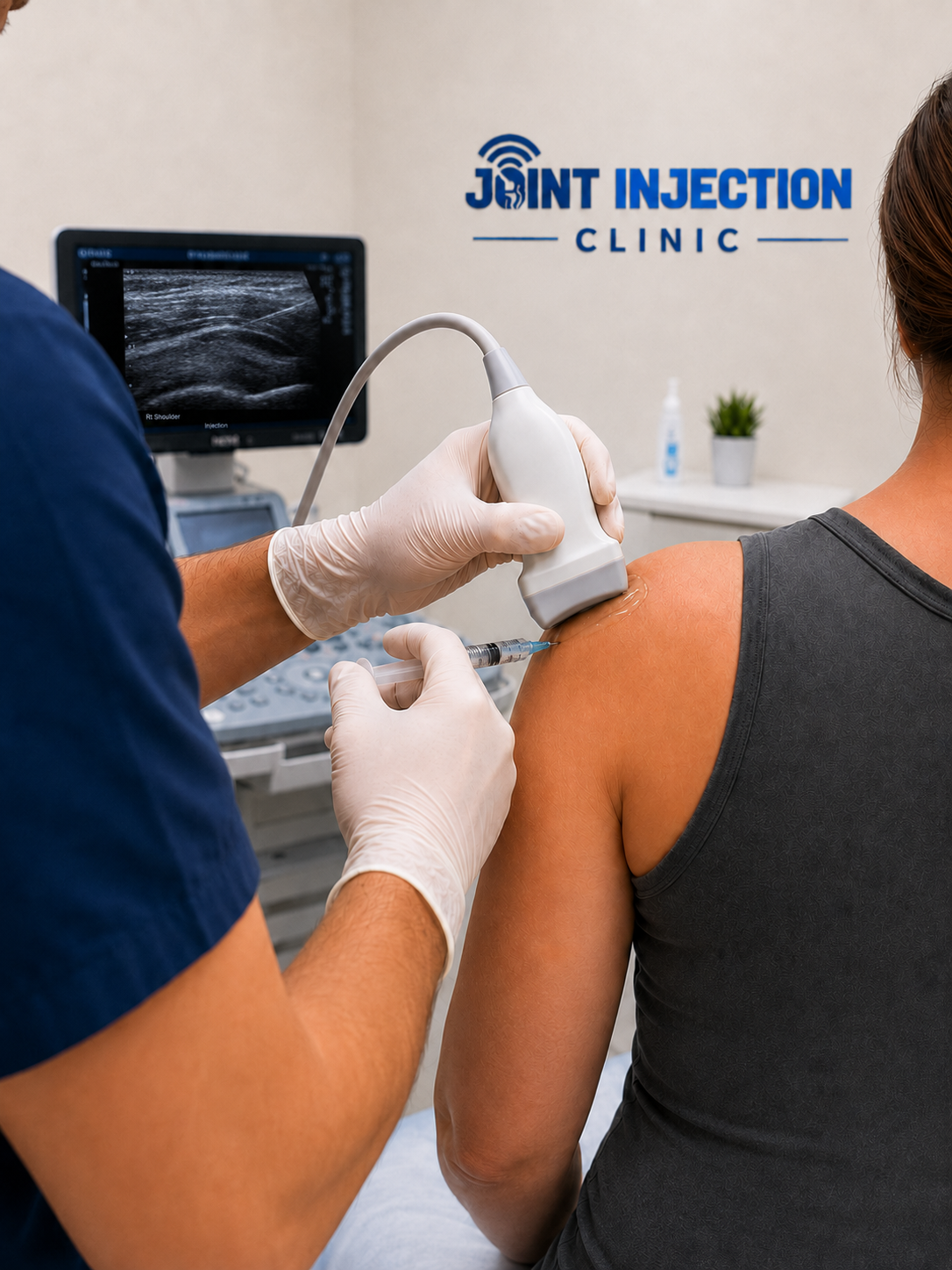
All injections are performed under real-time ultrasound guidance. This means the clinician can see the needle and target area during the procedure, helping to improve accuracy and reduce unnecessary irritation to surrounding tissues.
Why Choose Joint Injection Clinic Kings Hill for Guided Injections?
Joint Injection Clinic is a specialist private musculoskeletal clinic providing ultrasound-guided injections for joint, tendon, arthritis, and soft tissue pain. At our Kings Hill clinic, patients can access assessment, diagnostic ultrasound, and guided injection treatment in one appointment where clinically appropriate.
Patients choose us for:
Our aim is to provide accurate assessment, targeted treatment, and clear guidance so you can make an informed decision about your musculoskeletal care.
Injection Treatments Available at Our Kings Hill Clinic
Suitability for injection therapy is assessed individually. Your clinician will examine your symptoms, review your medical history, and use ultrasound imaging where appropriate before recommending the most suitable treatment option.
Ultrasound-Guided Corticosteroid (Steroid) Injections
Cortisone and steroid injections are commonly used to reduce inflammation and pain in joints, tendons, bursae, and soft tissue structures.
At Joint Injection Clinic Kings Hill, steroid injections are delivered under ultrasound guidance to improve accuracy. This is especially important when treating deeper joints, smaller joints, bursae, tendon sheaths, or areas where precise placement can influence the outcome.
Steroid injections may be considered for conditions such as bursitis, frozen shoulder, arthritis-related joint pain, tendon sheath inflammation, trigger finger, De Quervain’s tenosynovitis, and selected soft tissue pain conditions.
Ostenil Plus / Hyaluronic Acid Injections
Ostenil Plus is a hyaluronic acid injection used for selected cases of osteoarthritis and joint-related pain. It works differently from steroid injections. Instead of focusing mainly on inflammation, hyaluronic acid helps support joint lubrication and movement.
This option may be suitable for patients with knee, hip, shoulder, or other joint osteoarthritis where a non-steroid injection option is preferred or where repeated steroid use is not ideal.
Your clinician will assess whether Ostenil Plus is appropriate based on your symptoms, ultrasound findings, joint health, and treatment goals.
Hydrodistension for Frozen Shoulder
Hydrodistension may be recommended for suitable patients with frozen shoulder. Frozen shoulder can cause significant pain, stiffness, and loss of movement due to tightening of the shoulder capsule.
During hydrodistension, fluid is injected into the shoulder joint under ultrasound guidance to help stretch the capsule and improve joint movement. A steroid may also be used where clinically appropriate to help reduce inflammation and pain.
This treatment is usually considered when frozen shoulder symptoms are limiting function and not improving with standard care.
Barbotage for Calcific Tendinopathy
Barbotage may be used for selected patients with calcific tendinopathy, most commonly affecting the rotator cuff tendons in the shoulder.
In this condition, calcium deposits can develop within the tendon and cause severe pain, inflammation, and restricted movement. Barbotage uses ultrasound guidance to locate the calcium deposit, break it down, and remove or reduce it where possible.
Your clinician will confirm whether this procedure is suitable after assessment and ultrasound examination.
Conditions Treated with Ultrasound-Guided Injections at Kings Hill
Ultrasound-guided injections may be considered for a range of musculoskeletal conditions. Listing a condition below does not mean that an injection will always be recommended. Suitability depends on your diagnosis, symptoms, medical history and previous treatment. For many tendon conditions, physiotherapy, progressive rehabilitation or shockwave therapy may be more appropriate than an injection.
Why Choose Ultrasound-Guided Injections?
Ultrasound guidance allows your clinician to see the affected structure and guide the needle in real time. This can make the procedure more accurate than a landmark-guided injection, where the injection is placed using touch and surface anatomy alone. Read more about why choose an utrasound guided injection over standard injection?
Key benefits include:
For many patients, the goal of injection therapy is to reduce pain and inflammation enough to improve movement, support recovery, and make rehabilitation more effective.
What to Expect at Your Kings Hill Injection Appointment
We understand that many patients feel unsure about having an injection, especially if it is their first time. At Joint Injection Clinic Kings Hill, your appointment is designed to be clear, calm, and clinically guided from start to finish.
You will not be rushed into treatment. Your clinician will first assess your symptoms, explain what may be causing your pain, and discuss whether an ultrasound-guided injection is suitable for your condition.
1. We Listen to Your Symptoms First
Your appointment begins with a detailed discussion about your pain, how long it has been present, what makes it worse, and how it is affecting your movement, work, sleep, sport, or daily activities. This helps your clinician understand the full picture before recommending treatment.
2. Your Clinician Examines the Affected Area
A focused musculoskeletal assessment is carried out to check movement, tenderness, strength, joint function, and the structures that may be contributing to your symptoms. This step helps confirm whether your pain is likely coming from a joint, tendon, bursa, ligament, or surrounding soft tissue.
3. Ultrasound Is Used Where Clinically Appropriate
If needed, diagnostic ultrasound is used during the appointment to look more closely at the affected area. This can help identify inflammation, fluid, tendon changes, bursitis, arthritis-related changes, or other soft tissue findings. The scan also helps your clinician decide the most accurate target for treatment.
4. Your Treatment Options Are Explained Clearly
If an injection is suitable, your clinician will explain the recommended option, expected benefits, possible risks, aftercare advice, and what the injection is intended to achieve. You will have the opportunity to ask questions before going ahead.
5. The Injection Is Guided in Real Time
The injection is performed using ultrasound guidance, allowing your clinician to see the needle and target area throughout the procedure. This helps deliver the medication accurately to the affected joint, tendon sheath, bursa, or soft tissue structure.
6. Clear Aftercare Advice and Written Report
After the injection, your clinician will explain what to expect, how to manage the first few days, what activities to avoid temporarily, and when to return to normal movement or rehabilitation.
You will receive a written report summarising your assessment findings, relevant ultrasound findings, injection details and recommended next steps.
Private Injection Clinic Near You in Kings Hill, West Malling
Joint Injection Clinic Kings Hill is located at: Office 53, Ground Floor, Regus Kings Hill Business Centre, 26 Kings Hill Avenue, West Malling, ME19 4AE
The clinic is based within Kings Hill Business Park, close to West Malling, Leybourne, Larkfield, East Malling, Aylesford, Maidstone, and Tonbridge.
For patients travelling by car, Kings Hill is well placed for access from the A228 and M20. Paid parking is available at the Regus building, and a bus stop is located nearby on Kings Hill Avenue.
If you are searching for private cortisone and steroid injections near you in Kings Hill, West Malling, Maidstone, or mid-Kent, Joint Injection Clinic provides specialist assessment and injection therapy without needing a GP referral.
📞 Call us: 01322 842 402
✉️ Email: info@jointinjectionclinic.co.uk
Opening hours: Monday – Friday: 09:00 – 18:00 Wednesday: 09:00 – 17:30 Saturday: 09:00 – 17:00 Sunday: 11:00 – 15:00
Request a Guided Injection appointment at Kings Hill Clinic
Other MSK Services We Provide at Our Kings Hill Clinic
Alongside ultrasound-guided injections, our Kings Hill clinic offers a wider range of musculoskeletal care under one roof:
Ultrasound-guided injections are also available at our Dartford Clinic, Romford Clinic, and Canterbury Clinic.
Frequently Asked Questions